



Across contemporary engineering programmes encompassing systems engineering, diagnostics, testing, supportability and long-term sustainment, a persistent and increasingly critical challenge has emerged.
Tools employ different data structures, formats, and assumptions. Terminology varies across domains, with identical words often carrying entirely different meanings. As organisations accelerate their digital transformation, the volume and complexity of engineering data continue to grow alongside the difficulty of interpreting, exchanging and reusing it with consistency.
The consequences are significant: miscommunication between teams, redundant work, incompatible models, and design knowledge that becomes difficult if not impossible to leverage across the system lifecycle or revive for future programmes.

In response, engineering organisations have explored multiple approaches to digital integration. Each offers distinct advantages and limitations, yet all aim to address the same overarching question:
How can we establish a reliable, coherent, and enduring digital representation of a system that is accessible and meaningful across all engineering disciplines?
1. The Centralized “Master Model” Approach
This strategy creates a single, authoritative repository often rooted in MBSE that contains all project data. Every tool translates to and from this central model.
Strengths
- A genuine single source of truth
- Strong configuration control
- Easier multi-purposing of project data
- Promising long-term ROI
Challenges
- High upfront investment and infrastructure needs
- Internal politics over update permissions
- Semantic inconsistencies still emerge when domains use conflicting terminology
- Updates can ripple unpredictably across dependent teams
The master-model approach tries to eliminate fragmentation, but semantic gaps across engineering disciplines still make integration difficult.
2. Interconnected Centers of Expertise (Distributed/PLM-Style)
Instead of centralising everything, this model allows each discipline to maintain its own independent data and tools. Integration happens selectively only where it delivers value using APIs or translators.
Strengths
- Lower cost of entry
- Faster ROI
- Teams maintain control of their own data
- Integration introduced only where needed
Challenges
- Semantic incompatibilities remain a persistent issue
- Versions of the design can diverge as data is duplicated
- Configuration control becomes a web of interconnected dependencies
- Alignment discussions are frequent and unavoidable
This approach is flexible but struggles with the same fundamental challenge: shared meaning across disciplines.
3. The Standards-Based Digital Thread (A Third Way Forward)
This emerging strategy distributes models across disciplines as in the PLM-style approach but uses non-proprietary, standardised, well-defined formats to link them.
Here, the “authoritative source of truth” is the chain of standardised exchanges, not a single repository.
Strengths
- Low initial investment and fast ROI
- Substantial reduction in semantic ambiguity
- Creates an enduring, future-proof record of design knowledge
- Tool-agnostic interoperability
Challenges
- Some domains still lack robust standards
- Standards must be both precise (unambiguous) and extensible (project-adaptable)
- Extensions can trigger debates over ownership
- Distributed configuration control still requires innovation
Even with these challenges, a standards-based digital thread is increasingly seen as the most scalable and sustainable approach.
A Case Study: A Fully Standardised Digital Thread in Action
A demonstration presented between 2021 and 2022 showcased a closed-loop digital thread linking 11 engineering tools and activities from MBSE to diagnostics to sustainment analysis.
The flow includes:
- MBSE defines the system architecture.
- Diagnostic engineering generates diagnostic procedures and identifies test needs.
- Test engineering maps tests to signals and generates automatic test-program code.
- Run-time diagnostics interpret test results, guide troubleshooting, and feed empirical data back into the models.
- Sustainment simulations analyse historical diagnostic performance to refine maintenance strategies.
The key to making this possible: every activity reads and writes to standardised formats, ensuring continuity of meaning and traceability across the lifecycle.
eXpressML — A Critical Link in the Digital Thread
At the heart of diagnostic integration lies eXpressML, a non-proprietary format that documents the full diagnostic model developed in eXpress™.
What eXpressML Captures
- Component topology and connectivity
- Functional dependencies
- States and behavioural information
- Reliability data (failure modes, failure rates)
- Test definitions and coverage rules
- Custom attributes for project-specific extensions
- Global identifiers linking data across tools
Why eXpressML Matters
- High interoperability: Easily ingests MBSE, CAD, and reliability data before modelling diagnostic logic.
- Semantic clarity: Ensures consistent interpretation of diagnostic knowledge across teams.
- Long-term durability: Once enhanced in eXpress™, the model is exported back to eXpressML, forming a lasting, tool-agnostic representation of diagnostic engineering work.
In the case study, MBSE data is imported into eXpress™, enriched with functional dependencies and diagnostic rules, and then re-exported to eXpressML allowing downstream tools to consume it reliably.
eXpressML — A Critical Link in the Digital Thread
At the heart of diagnostic integration lies eXpressML, a non-proprietary format that documents the full diagnostic model developed in eXpress™.
What eXpressML Captures
- Component topology and connectivity
- Functional dependencies
- States and behavioural information
- Reliability data (failure modes, failure rates)
- Test definitions and coverage rules
- Custom attributes for project-specific extensions
- Global identifiers linking data across tools
Why eXpressML Matters
- High interoperability: Easily ingests MBSE, CAD, and reliability data before modelling diagnostic logic.
- Semantic clarity: Ensures consistent interpretation of diagnostic knowledge across teams.
- Long-term durability: Once enhanced in eXpress™, the model is exported back to eXpressML, forming a lasting, tool-agnostic representation of diagnostic engineering work.
In the case study, MBSE data is imported into eXpress™, enriched with functional dependencies and diagnostic rules, and then re-exported to eXpressML allowing downstream tools to consume it reliably.
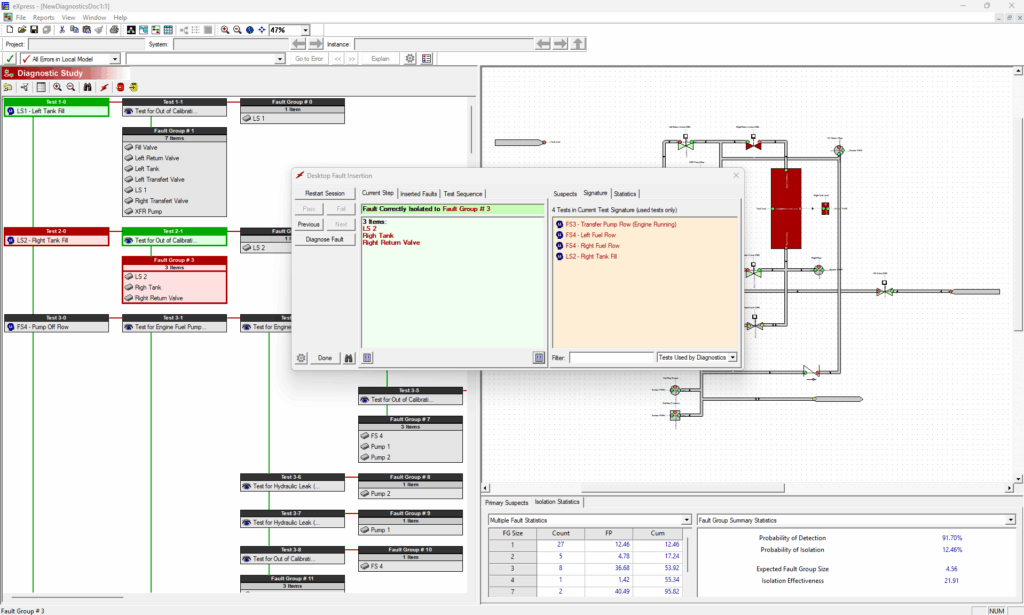
As organisations adopt standards-based digital threads and tools such as eXpress, many rely on Spherea for specialised expertise in testability engineering, diagnostics, and the development of optimised support strategies. We combine deep technical knowledge with practical programme experience to help organisations ensure system availability, reduce lifecycle costs, and strengthen engineering decision-making.
Our capabilities span the full spectrum of testability and supportability engineering. We support customers in validating system availability metrics such as detection rates and fault-location performance using advanced diagnostic modelling in eXpress™ and complementary RAMS methodologies.